
1099 vs W-2 in Florida: Are You Misclassified as an Independent Contractor?

If you’ve been hired by a company in Florida, one of the most important questions to understand is whether you are a W-2 employee or a 1099 independent contractor.
Many workers don’t realize there is a difference until something goes wrong — like not receiving overtime, being denied benefits, or being asked to pay unexpected taxes.
Understanding the difference between 1099 vs. W-2 classification in Florida can help you protect your rights and avoid being taken advantage of.
Why Worker Classification Matters
Your classification determines what legal protections and benefits you receive.
Some employers classify workers as 1099 independent contractors instead of W-2 employees because it reduces their costs. But in some situations, this classification is incorrect or even illegal.
If you are misclassified, you may lose important rights such as:
Overtime pay
Minimum wage protections
Employer tax contributions
Workers’ compensation coverage
Unemployment benefits
Certain workplace protections
Because of this, worker misclassification is a major issue in Florida employment law.
What Is a W-2 Employee?
A W-2 employee is someone who works directly for a company as an employee.
If you are a W-2 employee in Florida, the employer must:
Withhold taxes from your paycheck
Pay a portion of Social Security and Medicare taxes
Follow minimum wage laws
Pay overtime for hours worked over 40 per week under federal law (in most cases)
Provide unemployment insurance
Follow workplace protection laws
Signs You Are Likely a W-2 Employee
You may be an employee if:
- Your employer sets your schedule
- You are required to work specific hours
- The company provides your tools or equipment
- You are trained by the company
- You are expected to follow company policies
- You are subject to disciplinary action, such as warnings, write-ups, and suspensions
- Your work is a core part of the business
For example, if a restaurant hires a server and requires them to work specific shifts, directs them on how to interact with customers, and writes them up if they do not perform the way the manager would like, that person is a W-2 employee.
What Is a 1099 Independent Contractor?
A 1099 worker is considered an independent business owner who provides services to a company.
Independent contractors usually:
Control how and when they perform their work
Use their own tools or equipment
Work for multiple clients
Send invoices for their services
Pay their own taxes
Because they are considered self-employed, 1099 contractors are not entitled to many employee protections.
This means:
No guaranteed minimum wage
No overtime protections
No unemployment benefits
No employer-paid payroll taxes
However, true independent contractors typically have more control over their work and business decisions.
When Misclassification Happens
Sometimes workers are labeled as 1099 contractors even though they function like employees.
This is known as worker misclassification.
Common situations where misclassification occurs include:
Delivery drivers controlled by a company but paid as contractors
Salon workers required to follow strict schedules and policies
Office workers paid on a 1099 but treated like employees
In these situations, the worker may legally qualify as a W-2 employee under federal labor laws.
How the Law Determines Your Classification
Courts and government agencies look at the level of control the company has over the worker.
Factors often include:
Who controls the worker’s schedule
Who controls how the worker performs the job
Who provides tools or equipment
Whether the worker can work for other clients
How the worker is paid
Whether the work is essential to the business
No single factor determines the answer. Instead, the law looks at the full relationship between the worker and the company.
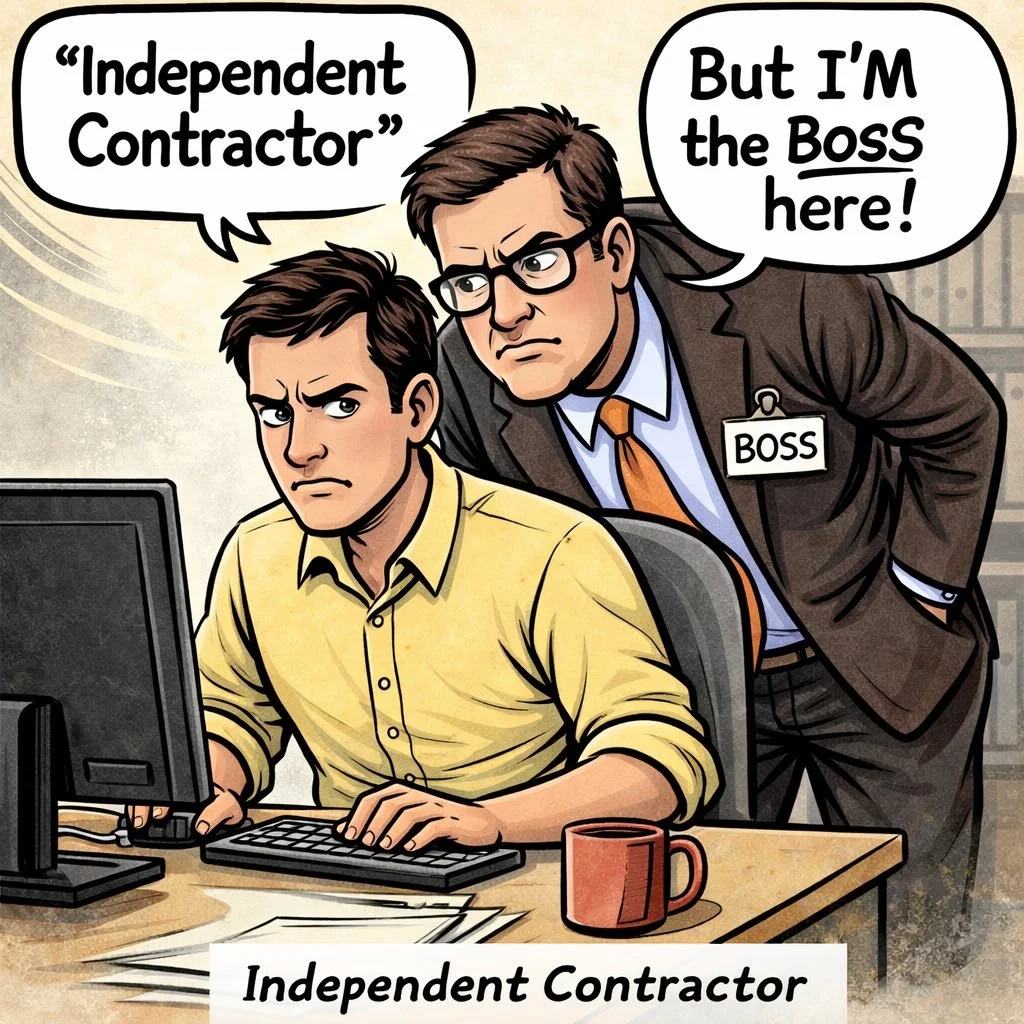
A worker labeled “independent contractor” is closely supervised by a boss, highlighting how control, not titles, determines classification.
What to Do If You Think You Are Misclassified
If you believe you were improperly classified as a 1099 contractor instead of a W-2 employee, you may have options.
You may be entitled to:
Unpaid overtime wages
Minimum wage violations
Reimbursement for business expenses
Tax adjustments
Other potential damages
Worker misclassification cases can be complex, but understanding the difference between 1099 vs. W-2 workers in Florida is the first step in protecting your rights.
Speak With a Florida Employment Attorney
If you have questions about your worker classification or believe your employer may have misclassified you, it may be helpful to speak with an employment attorney who understands Florida and federal labor laws.
At DZ Law, we help workers understand their rights and evaluate potential employment law violations.
Whether you have questions about 1099 vs. W-2 classification, unpaid overtime, or workplace retaliation, getting the right legal guidance can help you determine your next steps.
Key Takeaway
If your employer controls how, when, and where you work, there is a strong possibility that you should be classified as a W-2 employee rather than a 1099 contractor.
Understanding the difference can protect you from losing important wages and legal protections.
Think You May Be Misclassified? Let’s Talk
If you’re being paid as a 1099 contractor but your work feels more like an employee role, it may be worth getting clarity.
Misclassification can affect your pay, taxes, and legal protections. You can learn more on our Employee Rights page, or contact DZ Law PLLC to talk through your situation and understand your options.